


Automatic doors for factory cleanrooms: Airtight standards and dust control
In cleanroom production environments, the entrance door is a critical control point that determines the ability to maintain airtightness and prevent dust intrusion. Specialized automatic door systems help optimize pressure differential, limit air exchange, and ensure compliance with GMP and ISO standards. Join Thuy Linh Long to explore the most suitable automatic door solutions for your factory cleanroom.
1. The role of automatic doors in factory cleanroom systems
A cleanroom is an environment strictly controlled in terms of dust concentration, microorganisms, and airflow, so every entrance directly affects production quality. Automatic doors become a core component that helps maintain airtightness, stabilize pressure differential, and minimize the risk of cross-contamination between areas.
1.1 Specific requirements for airtightness and contamination control
Industries such as pharmaceuticals, electronics, food, and healthcare require cleanrooms to meet defined cleanliness levels according to ISO or GMP standards. Even a small gap at the door can allow fine dust and microorganisms to enter, disrupting the production process. Therefore, doors must be able to close completely and operate accurately in every cycle.
1.2 Risks of using conventional doors in production environments
Traditional manual doors often close slowly and depend on human operation, easily causing loss of clean airflow. Mechanical impacts can also generate particles from material surfaces, affecting equipment and products. These risks may lead to batch errors and increased reprocessing costs for factories.
1.3 Automatic doors - a key link in the dust control chain
Automatic doors for cleanrooms are designed with fast opening and closing mechanisms, uniform pressure force, and specialized sealing gaskets. The door only activates when people or carts approach, minimizing opening time and limiting air exchange between two pressure zones. As a result, the factory’s dust control chain operates more stably and safely.
2. Mandatory technical standards for cleanroom doors
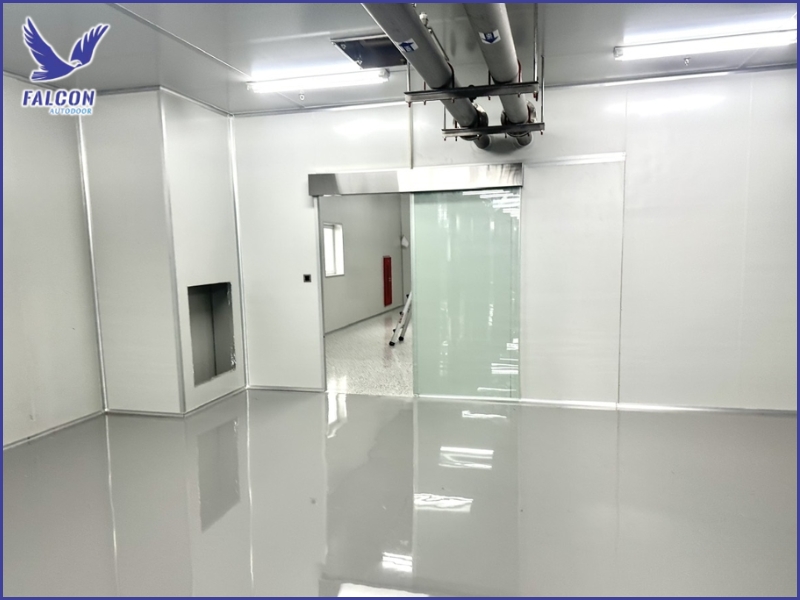
Automatic doors used in cleanrooms cannot be selected based on common criteria but must meet specialized technical standards. Every parameter from materials, airtightness, opening speed to HVAC integration directly affects the cleanliness level of the factory.
2.1 Airtight performance according to cleanroom class
The door leaf and frame must achieve high airtightness, minimizing air leakage to maintain pressure differential between rooms. Medical-grade rubber gaskets, multi-point compression structures, and precision rails help the door close tightly after each cycle. This is a prerequisite to meet ISO 5, ISO 7, or GMP cleanliness standards.
2.2 Dust-resistant and easy-to-clean materials
Door surfaces should use PU panels with electrostatic coating, stainless steel, or aluminum profiles that do not generate particles. Rounded designs with minimal gaps make cleaning with disinfectant solutions faster and easier. Standard materials must also resist corrosion in environments with frequent chemical cleaning.
2.3 Fast operation mechanism to limit air exchange
The opening and closing speed of cleanroom doors is usually set faster than residential doors to shorten the time the door remains open. Motors and controllers must operate stably without vibration to avoid generating mechanical particles. Auto-close mode when signal is lost helps protect room pressure in all situations.
2.4 Compatibility with pressure differential and HVAC systems
Automatic doors need to be synchronized with one-way airflow design, air showers, or pass boxes of the factory. Interlock signal integration ensures the door only opens when pressure differential reaches the allowed threshold, preventing system imbalance. This compatibility determines the overall effectiveness of the entire cleanroom.
3. Specialized automatic door solutions for cleanrooms
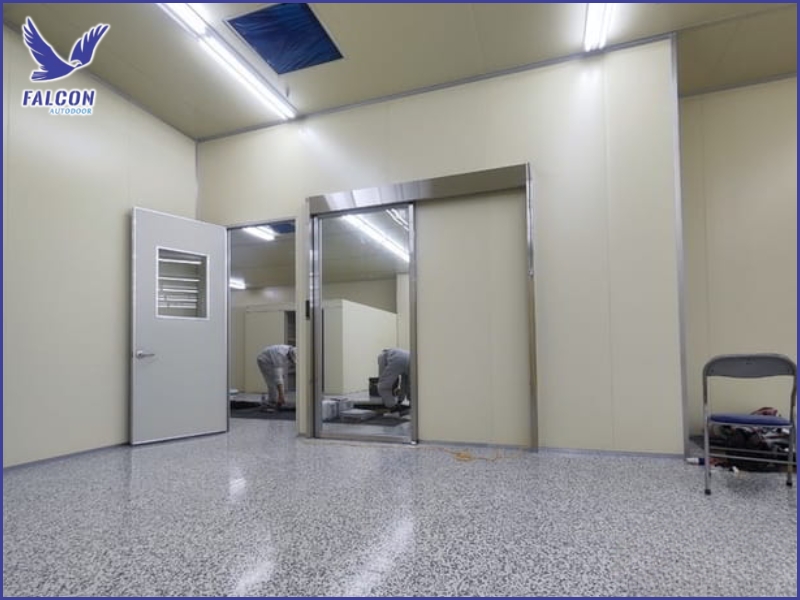
Depending on the production industry and cleanliness level, automatic doors for factories are designed with various configurations. Specialized solutions not only meet technical requirements but also optimize the movement process of personnel and goods in controlled areas.
3.1 Automatic sliding doors with PU panels, stainless steel, aluminum profiles
Sliding doors using PU insulation panels or stainless steel are preferred thanks to their airtightness and high durability. Flat surface structures with few joints reduce dust accumulation points and facilitate daily disinfection. Aluminum or stainless steel 304 frames ensure resistance to chemicals and high humidity.
3.2 Interlock system between door layers
In airlock or buffer zones, automatic doors are often configured with interlock so that two doors cannot open simultaneously. The interlock mechanism helps maintain stable pressure differential and prevents dirty airflow from entering cleaner zones. This is a mandatory requirement for many GMP-compliant factories.
3.3 Proximity sensors and touchless control
To minimize hand contact, cleanroom doors use proximity sensors, touchless buttons, or motion detection radar. This solution reduces cross-contamination risk and suits sterile processes. Fast response speed allows people and carts to move continuously without affecting room pressure.
3.4 Access control integration by area level
Automatic doors can connect with card systems, facial recognition, or shift-based authorization. Only authorized personnel can enter specific production areas, ensuring data traceability when needed. This integration supports factories in complying with audits from partners and regulatory agencies.
.jpg)
4. Experience in selection and installation to meet GMP/ISO standards
For automatic doors to truly deliver effectiveness in cleanrooms, selection and installation must strictly follow specialized standards. Even a small deviation in installation or configuration can affect cleanliness level and factory evaluation results.
4.1 Assessing personnel and goods traffic
Before choosing a door model, it is necessary to survey the number of movements of staff, carts, and materials in each production shift. High-frequency areas must use industrial motors, fast operation speed, and heavy-duty rails. Proper traffic calculation helps doors operate durably and avoid overload during peak hours.
4.2 Installation process ensuring airtightness and pressure differential
Cleanroom door installation requires precise control of gaps between frame and panel, using specialized gaskets and medical silicone. The door must be adjusted so that compression force is uniform around the entire perimeter, preventing air leakage when HVAC operates. All items need coordination with M&E units to synchronize control signals.
4.3 Acceptance testing: air leakage, dust, noise
After installation, doors must undergo tests on airtightness, opening time, noise level, and ability to maintain pressure differential. Measuring particle concentration before and after operation helps accurately evaluate actual performance. Acceptance documents need to be stored for future GMP and ISO audits.
4.4 Periodic maintenance to maintain cleanliness level
During operation, rails, gaskets, and sensors are prone to wear due to continuous activity. Factories should perform maintenance every 3-6 months to adjust speed, clean surfaces, and replace necessary components. Choosing an experienced provider like Thuy Linh Long ensures fast, standard technical service without disrupting production.
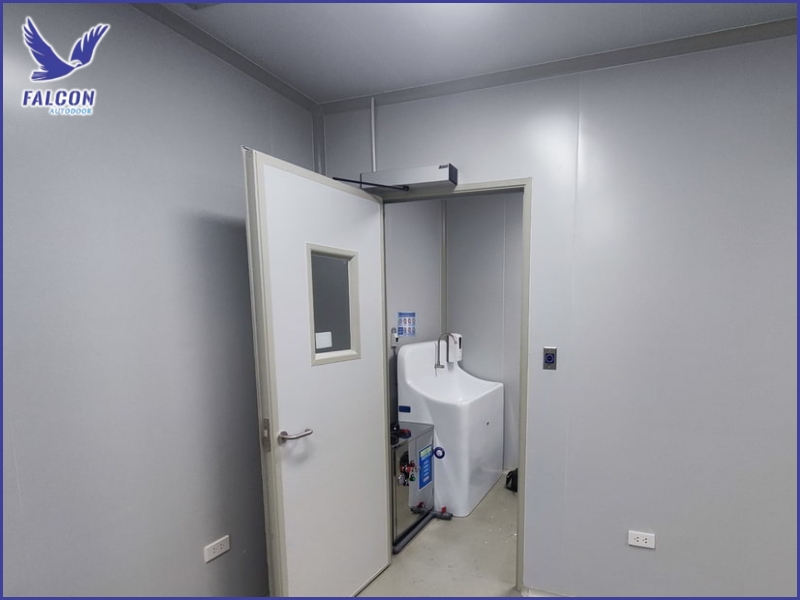
Automatic doors for cleanrooms are not just mechanical items but an important protective layer that helps factories maintain airtight standards and stable dust control. A suitable door solution will support HVAC systems to operate efficiently, limit cross-contamination, and ensure compliance with GMP and ISO requirements throughout production. This is a foundational investment for product quality and corporate reputation.
If your factory needs consultation on specialized automatic door solutions for cleanrooms, Thuy Linh Long is ready to accompany you from survey, design to installation and technical maintenance. Contact us today to receive an optimal plan based on actual cleanliness level, helping the production line operate safely, stably, and sustainably.
THUY LINH LONG SERVICES TRADING COMPANY LIMITED
DISTRIBUTOR
Address: 243D Vuon Lai Street, Phu Tho Hoa Ward, Tan Phu District,
Ho Chi Minh City, Vietnam.
Tel: +84 28 22497999
E-mail: cuatudong24h@gmail.com
SUPPLIER
KUM YANG MATERIALS CO.,LTD
Address: 124-60, Myeongdong-ro, Hallim-myeon,
Gimhae-si, Gyeongsangnam-do, 50851, Korea.
Tel: 82-55-345-8380


